
How a spelling mistake made during a refugee journey followed one family to Australia and eventually ended up on a Vegemite jar
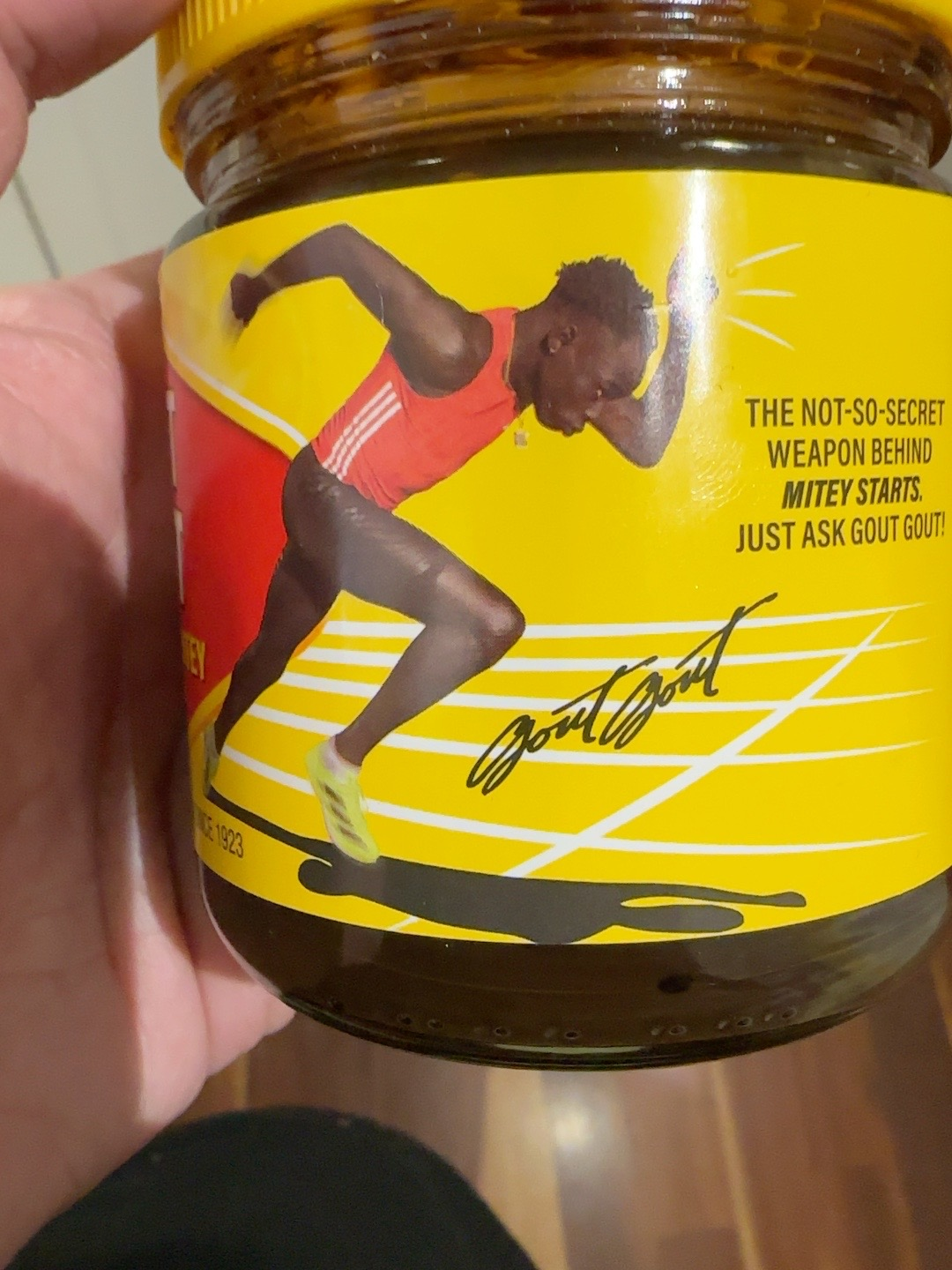
I don’t really follow athletics these days.
So when I recently came across a limited-edition Vegemite jar featuring an Australian runner called Gout Gout, my first reaction had very little to do with sport.
It was simply:
Why does this runner have the same name as a disease?
Because if you know the word gout, you probably associate it with an extremely painful form of inflammatory arthritis.
You probably don’t associate it with somebody capable of running 200 metres in less than 20 seconds.
And yet there it was.
GOUT GOUT
Printed across the front of a Vegemite jar.
At first I assumed Gout Gout must simply have one of those names that sounds unfortunate when translated into English.
But then I started looking into it.
And it turns out that Gout isn’t really how his family name was supposed to be written at all.
The explanation goes back years before he was born.
But before getting to that, there is another question.
Who exactly is Gout Gout, and why is he famous enough to have his own Vegemite jar?
First, just how fast is Gout Gout?

Gout Gout is an Australian sprinter from Queensland who has become one of the most exciting young athletes in world track and field.
And he is extraordinarily fast.
On 12 April 2026, at the Australian Championships in Sydney, Gout ran the 200 metres in:
19.67 seconds.
That made him the first Australian man to legally break the 20-second barrier over 200 metres.
It also broke the official World Under-20 record of 19.69 seconds, previously held by American sprinter Erriyon Knighton.
World Athletics subsequently ratified Gout’s 19.67 as the new World Under-20 record. (World Athletics)
There is an interesting technicality here.
Knighton had previously run an even faster 19.49 as an Under-20 athlete, but that performance was never ratified as the official world record.
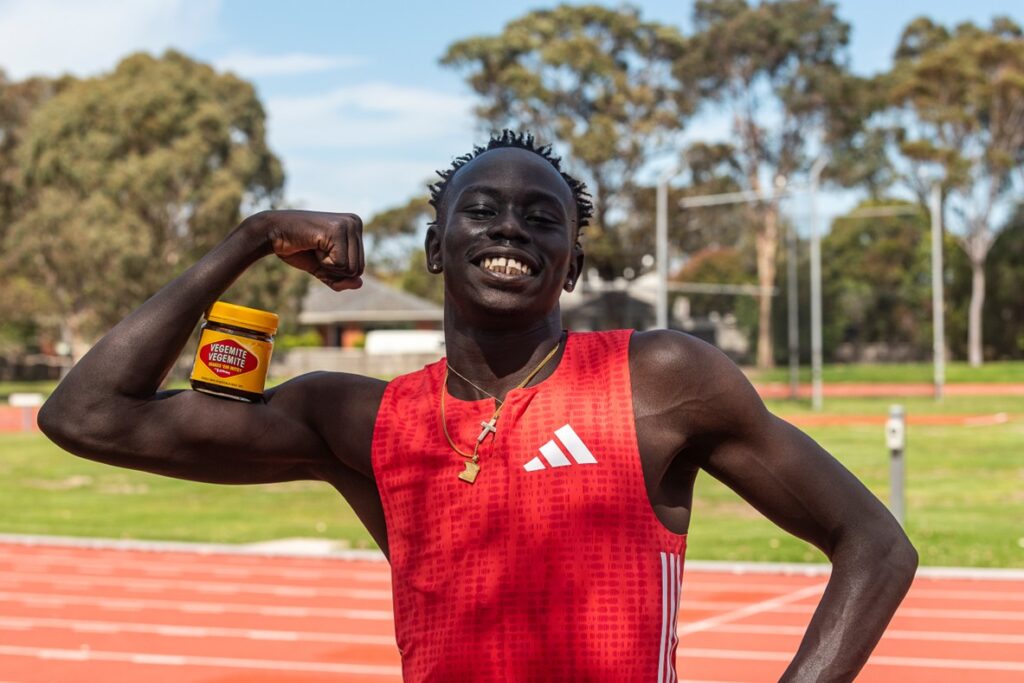
So Gout’s 19.67 is the official World U20 record, rather than the fastest Under-20 performance ever recorded under any circumstances. (World Athletics)
And if you’re wondering about Usain Bolt, Gout’s 19.67 also puts him ahead of Bolt’s best Under-20 time on the all-time list. (World Athletics)
That gives you some idea of just how unusual this young Australian is.
Born in Brisbane on 29 December 2007, Gout was only 18 when he produced the 19.67-second run. (World Athletics)
So the Vegemite connection makes a little more sense.
Which eventually resulted in the jar that started this whole train of thought.
But none of that answered my original question.
Why is his name Gout Gout?
His name isn’t actually supposed to be pronounced “Gout”
This is where things become much more interesting.
Gout’s parents are Bona and Monica, originally from South Sudan.
Their family name was written:
Guot
And it is pronounced approximately:
“Gwot.”
So the name was never supposed to sound like the English word gout.
According to the account Gout’s parents later gave to 7NEWS, Bona and Monica fled South Sudan and travelled through Egypt.
During that process, somewhere in the official paperwork, their name Guot was incorrectly rendered as:
Gout
7NEWS described it as an Arabic spelling mix-up involving Sudanese government paperwork.
So:
GUOT
became:
GOUT
And apparently the mistake simply went unnoticed. (7NEWS)
That is an incredibly small mistake
Two letters in the wrong order.
But when that mistake is sitting on government paperwork, it can become surprisingly difficult to escape.
And importantly, this happened before Gout Gout was born.
His parents already had the misspelled version of their family name attached to their documentation.
That distinction completely changes the story.
His parents didn’t sit down one day and decide:
Let’s name our child after a painful form of arthritis.
The spelling mistake was already there.
Rather than relying entirely on me retelling the story, this is probably the best point to hear it from Gout Gout’s father himself.
Caption: Bona explains the paperwork mistake behind the family name and why his son’s name should properly be Guot.
Bona later explained publicly how Guot became Gout and why the difference matters to his family.
Once I understood the sequence properly, I realised why I had initially been confused.
Looking at a Vegemite jar in Australia in 2026, all I could see was an athlete with what appeared to be the same name as a disease.
But the real sequence stretched across countries and decades.
So I made a little comic page to lay the story out visually.

Caption: My visual retelling of how the Guot family name became Gout during the family’s journey to Australia.
Call me Gout
There is an interesting final twist. While his father would prefer the original family spelling, Guot, to be restored. But Gout himself appears to have made peace with the name he has carried all his life. When the issue became public in December 2024, he responded through his agent with three simple words: “Call me Gout.”
And that is essentially what happened. Despite his father’s preference for Guot, the young sprinter continued competing as Gout Gout and by 2026 that is still the name under which World Athletics officially records his results and world Under-20 record.

Sources and further reading
The main sources I used while following this rabbit hole were 7NEWS, which interviewed Bona and Monica about the origin of the name; World Athletics, for Gout’s 19.67-second World Under-20 record; Australian Athletics, for biographical information about Gout and his family; and Vegemite, for information about its partnership with Gout. (7NEWS)
Read the original 7NEWS story about Gout Gout’s name
World Athletics report on Gout’s 19.67-second run
Australian Athletics profile and background