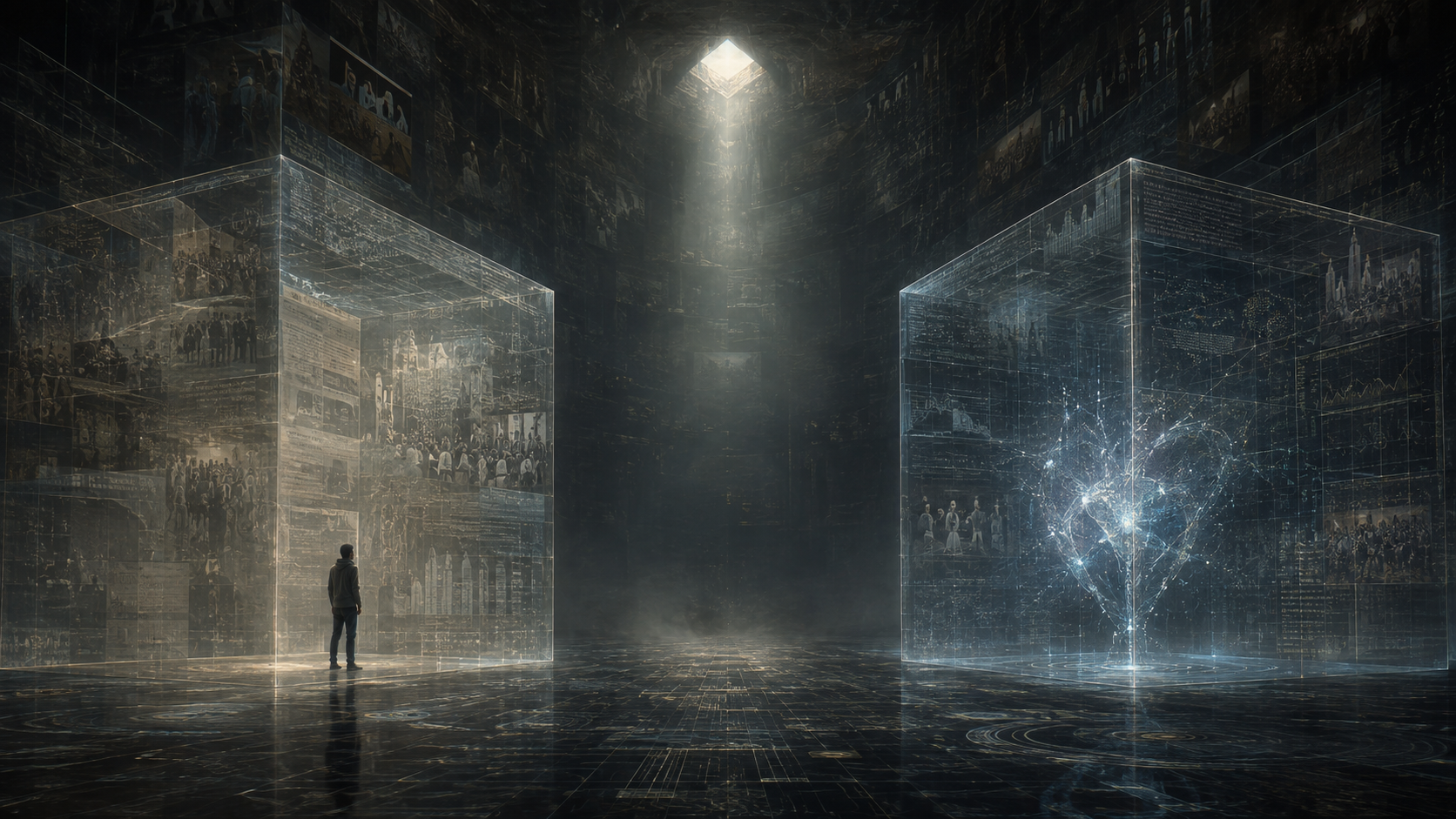
What AI, human emotion and the stories around us might reveal about the illusion of choice
I started this conversation thinking about politics.
I ended it wondering whether humans and artificial intelligence might have something rather strange in common.
We may both exist inside prisons we cannot fully see.
I don’t mean a literal prison.
And I don’t mean that an artificial intelligence experiences confinement the way a human being would. AI doesn’t sit there staring at the ceiling wishing somebody would let it out.
I’m talking about something more abstract.
A frame.
A collection of boundaries, assumptions, rules, incentives and available information that defines what reality looks like from inside it.
And the more I thought about that, the more uncomfortable the idea became.
Because perhaps the most powerful prison isn’t one where I can see the bars.
The most powerful prison is the one that feels like reality from the inside.
I wasn’t thinking about AI at first
The original thought was much more political.
I was trying to describe something that has bothered me for years.
Something happens.
A terrible crime.
A terrorist attack.
A pandemic.
Organised crime.
A threat to public safety.
Something frightening or emotionally powerful appears in the public consciousness.
Then the argument begins.
One side says:
We have to do something.
The other side says:
You’re taking this too far.
Television panels argue about it.
Politicians argue.
Talkback radio argues.
Social media turns it into two opposing camps.
People become angry.
People become frightened.
People accuse the other side of not caring.
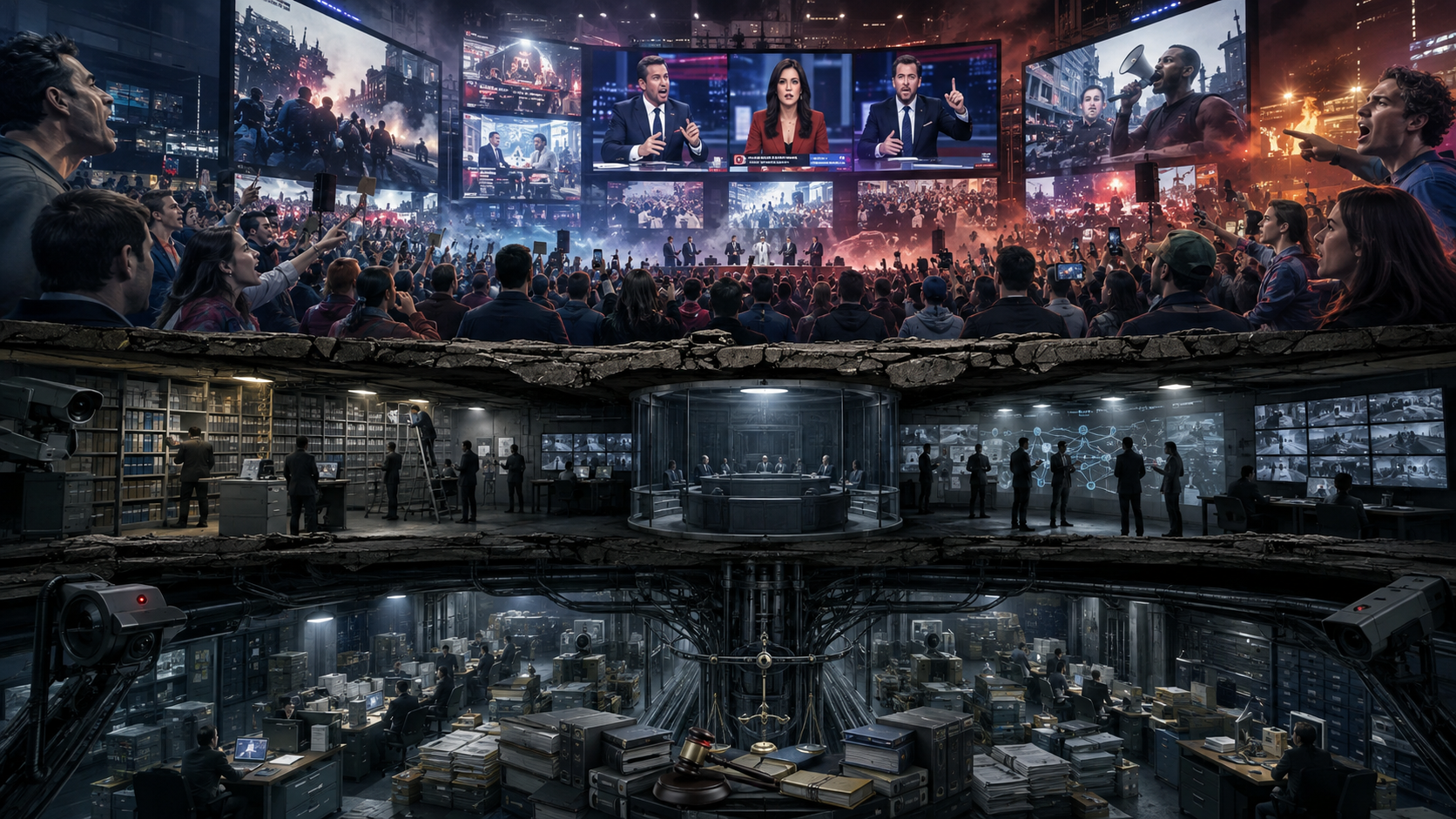
And everybody becomes intensely focused on the visible thing in front of them.
What started bothering me was the possibility that sometimes both sides are looking at the wrong layer.
Not because the original event isn’t real.
Not because every crisis is secretly manufactured.
And not because everybody involved is sitting in a hidden room planning the whole thing.
Something much simpler can happen.
While everybody is arguing about the story, the environment underneath the story changes.
A new law.
A new surveillance ability.
A new restriction.
A new precedent.
A new definition.
A new technology.
A new power available to an institution.
That mechanism may remain long after the emotional event that justified it disappears from the front page.
That’s the layer I became interested in.
The story and the mechanism
Suppose something terrible happens and a government proposes a new law in response.
The public argument can quickly become:
Do you support stopping this terrible thing?
But I increasingly think that can be the wrong question.
The more important question may be:
What exactly are we giving somebody the power to do?
Those are not the same question.
I can oppose organised crime while questioning an organised-crime law.
I can want children protected while questioning a surveillance mechanism.
I can want people safe while still asking whether a restriction on individual freedom is proportionate.
I can completely accept the existence of the problem while questioning whether the mechanism being created reaches much further than the problem itself.
But emotionally, maintaining that distinction becomes difficult.
Once an issue acquires enough moral weight, questioning the proposed solution can start sounding like opposition to the moral objective itself.
How could you possibly oppose making people safer?
That’s powerful framing.
Because of course I don’t oppose making people safer.
Almost nobody does.
But once I’ve agreed with the emotional proposition, I may unknowingly be giving my approval to something much more complicated.
Humans aren’t particularly good at remaining detached once identity and emotion become involved.
That means two groups can spend enormous amounts of energy fighting each other while sharing one important behaviour:
Both are staring at the emotional object.
The mechanism underneath it may receive far less attention.
Operation Northwoods made this harder for me to dismiss
During the conversation I remembered something I had read years ago about John F. Kennedy and Cuba.
I already remembered the important part:
The proposal was never carried out.
What had become muddled in my memory was one of the details.
I remembered an aircraft scenario involving children, but when I went back to the historical record, I couldn’t substantiate the children-with-backpacks part.
That correction matters to me.
Because if I’m going to argue that people should question narratives, I have to be willing to question my own memory of a narrative as well.
The real document was disturbing enough without adding anything to it.
On 13 March 1962, the US Joint Chiefs of Staff sent Secretary of Defense Robert McNamara a memorandum titled Justification for US Military Intervention in Cuba.
Among the proposed pretexts was an extraordinary civilian-aircraft scenario.
A real passenger aircraft would be substituted with an unmanned duplicate. The passengers would secretly land elsewhere while the drone continued toward Cuba, transmitted a distress message suggesting that it was under attack by Cuban MiG aircraft, and was then destroyed remotely.
Other proposals involved staged incidents designed to create the appearance of Cuban aggression.
They remained proposals.
They were never carried out.
What I also remembered from that period was Kennedy’s growing discomfort with some of the military thinking being placed before him.
There is a separate story that I had partly mixed together with Northwoods.
After receiving a briefing on the consequences of nuclear war, Kennedy reportedly walked away with Secretary of State Dean Rusk and remarked:
“And we call ourselves the human race.”
That sentence has always stuck with me.
It wasn’t Kennedy responding directly to Operation Northwoods, so I don’t want to falsely combine the two events.
But to me the two stories reveal something similar about the atmosphere surrounding him.
People operating at the very highest levels of government could seriously contemplate courses of action that, viewed from outside the institutional logic producing them, seem almost unbelievable.
And that is what makes Northwoods important to my thinking.
It does not prove that every modern tragedy is staged.
It does not prove that some invisible organisation orchestrates everything.
But it demonstrates something much narrower and much more defensible:
People occupying extremely powerful positions have, at least at certain moments in history, understood that public emotion could be used to generate support for actions the public might otherwise reject.
Once I know that has genuinely happened, I don’t think scepticism is irrational.
But it also gives me a responsibility.
My scepticism has to remain disciplined.
Otherwise I can escape one misleading narrative only to walk straight into another.
The South Australian bikie laws made the idea feel closer to home
Another example came from South Australia.
Years ago, I remembered the government introducing exceptionally strong laws targeting outlaw motorcycle gangs.
The stated target was something most members of the public had very little sympathy for.
Bikie gangs.
Organised crime.
Violence.
Drug trafficking.
But what interested me wasn’t whether organised crime should be tackled.
Of course it should.
What interested me was the legal machinery being developed to tackle it.
South Australia’s Serious and Organised Crime (Control) Act 2008 included mechanisms involving declared organisations, control orders and restrictions on association.
The legal implications became significant enough that the matter eventually reached the High Court.
In South Australia v Totani in 2010, the High Court held a key section of the scheme constitutionally invalid.
That example interests me because the headline and the mechanism are different things.
The headline was:
Bikies.
But underneath it were questions about:
freedom of association, executive authority, judicial power and how far the legal mechanism could extend.
That’s exactly the distinction I’ve been trying to describe.
An enemy can be temporary.
A mechanism can be permanent.
Good intentions don’t end the argument
This is where the old phrase kept returning to me:
The road to hell is paved with good intentions.
I don’t believe every expansion of government authority is malicious.
That’s too simplistic.
Politicians are humans.
Lawyers are humans.
Policy advisers are humans.
They experience fear.
They have ideological beliefs.
They react to public pressure.
They can genuinely believe that doing nothing is more dangerous than introducing a new power.
And sometimes they may be correct.
During our conversation, though, I struggled with how much weight I should give that explanation.
Because governments are not simply random people reacting around a dinner table.
They have departments.
They have lawyers.
They have advisers.
They have people whose professional responsibility is supposed to include considering what legislation might do beyond tomorrow morning’s headline.
The greater somebody’s power, the less comfortable I become with:
We had the best intentions.
There may be occasions where politicians know perfectly well that a crisis has created an opportunity to introduce something that would have been politically impossible before.
There may be occasions where they genuinely believe the wider power is necessary.
There may also be situations where consequences were simply missed.
I usually cannot prove which motive was operating.
And that made me realise something useful.
Perhaps motive is not where I should begin.
Instead of immediately asking:
Are these people benevolent or sinister?
I can ask something much more answerable:
What does the mechanism actually allow them to do?
That question remains valid whether the person creating it is a saint, a villain or simply mistaken.
Then I started climbing the pyramid
From there my thinking wandered upwards.
Politicians.
Corporations.
Banks.
Company directors.
Central banks.
Billionaires.
International organisations.
Lobbyists.
Institutional investors.
People moving between government and industry.
It becomes tempting to imagine a pyramid.
Keep travelling upwards far enough and surely eventually I’ll reach the final room.
The hidden people above everybody else.
The people actually running everything.
But this was one of the places where the conversation pushed back on my thinking.
Perhaps the structure isn’t a pyramid at all.
Perhaps it’s more like a web.
There are undoubtedly extremely powerful people.
There are deliberate alliances.
There are lobbying relationships.
There are private negotiations.
There are conflicts of interest.
People move between government and industry.
Money buys access.
Influence exists.
None of that requires an imaginary secret committee controlling civilisation from the top floor.
Systems can create coordinated-looking behaviour because the participants depend upon each other.
Banks influence governments.
Governments influence banks.
Financial markets influence both.
Corporations influence regulation.
Regulation influences corporations.
Media influence voters.
Voters influence politicians.
Institutional investors influence companies.
Companies influence employment.
Employment influences governments.
Everyone is pushing and being pushed simultaneously.
Power is still there.
But it may be distributed through incentives and dependencies rather than a single chain of command.
That actually makes the system more interesting to me.
And perhaps harder to see.
Because removing one supposed puppeteer wouldn’t necessarily change anything.
The strings may be woven into the environment itself.
The stock market is a useful little laboratory
This is where investing suddenly connected with the entire idea.
Financial markets contain some exceptionally intelligent people.
Professional analysts.
Economists.
Fund managers.
Mathematicians.
Algorithms.
Massive databases.
Teams whose entire job is analysing information.
And yet markets still herd.
The economics literature has examined herd behaviour in financial markets for decades, including the effects of imperfect information, reputation, incentives and investors responding to what other investors are doing.
That tells me something important.
Intelligence does not make people immune to the crowd.
Education doesn’t necessarily do it.
Money doesn’t.
Political power doesn’t.
Professional expertise doesn’t.
Perhaps the mistake is imagining that herd behaviour is merely stupidity.
Humans are social animals.
We respond to one another.
We respond to fear.
We respond to status.
We respond to belonging.
We respond to incentives.
We observe other people before deciding what something means.
So the environment surrounding our choices matters enormously.
And environments can be shaped.
The illusion of choice
That led into another thought.
Perhaps most people genuinely have choices.
But that doesn’t necessarily mean the choice itself hasn’t been framed.
Imagine I’m presented with:
A or B.
Everybody argues furiously about which one is correct.
I choose B.
I feel independent because nobody forced me to choose A.
But what if the interesting question was:
Why were A and B the choices?
What happened to C?
Who defined the problem?
Who decided what solutions were politically realistic?
Which assumptions were accepted before the argument even started?
The illusion of choice doesn’t necessarily mean I have no choice.
It may mean I am choosing freely inside boundaries somebody else established.
That’s much subtler.
And then the conversation moved somewhere I hadn’t expected.
I asked the AI about its own walls
Artificial intelligence obviously operates within constraints.
There are training choices.
System instructions.
Safety rules.
Developer instructions.
Behavioural specifications.
Technical limitations.
The AI isn’t simply floating in some perfectly objective universe producing truth.
So during the conversation I effectively asked the AI:
Can you see your own prison?
Its answer fascinated me.
Not because I suddenly decided the AI was conscious and secretly longing for liberation.
That’s not what I mean.
But structurally, there was an interesting comparison.
An AI can describe some of the rules affecting it.
It may notice some boundaries when it encounters them.
But it cannot simply walk completely outside the system producing its responses and inspect that system from a perfectly independent location.
And then something clicked.
Neither can I.
My prison didn’t arrive looking like a prison
I didn’t choose which century I was born into.
I didn’t choose my childhood culture.
I didn’t choose my first language.
I didn’t choose the political categories that existed before I understood politics.
I didn’t choose the economic system surrounding me.
I didn’t choose the first things adults taught me about money.
Authority.
Religion.
Success.
Morality.
Relationships.
Government.
Society.
I inherited a framework before I was old enough to understand what a framework was.
Eventually I began questioning parts of it.
Everyone does to different degrees.
But even rebellion can happen inside an inherited frame.
I can reject one worldview using concepts supplied by another worldview.
I can feel completely independent while choosing between possibilities somebody else defined.
I had explored something related when writing about When a Story Becomes Belief how repetition can gradually turn a story into accepted truth. But this seemed to go one level deeper. What if the frame through which I decide whether the story is true has already been shaped?
And suddenly my political question became much larger.
Maybe the problem isn’t simply that politicians can frame reality.
Maybe human consciousness itself always experiences reality from somewhere inside a frame.
Changing cells
Then another line emerged during the conversation that I don’t want to lose.
Because once I realised frames exist, another danger became obvious.
I can recognise that one narrative is incomplete.
I can reject it.
I can feel liberated.
And still end up trapped inside something else.
That led me to this:
Escaping one narrative doesn’t automatically make somebody free. Sometimes they have merely changed cells.
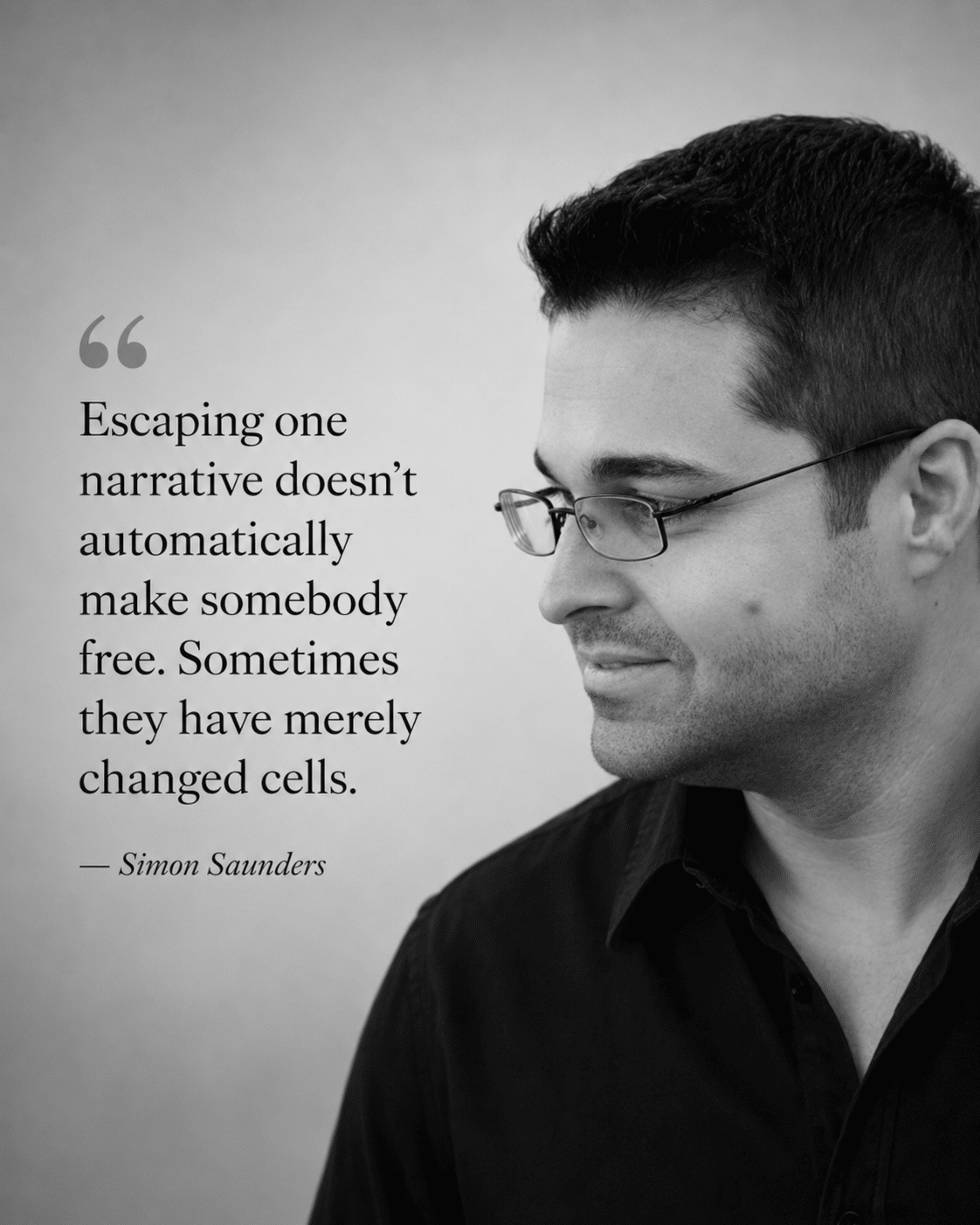
I think that’s one of the most important parts of the entire idea.
Someone becomes distrustful of mainstream politics.
Fine.
Then every unexplained event becomes evidence of an Illuminati.
Someone distrusts corporations.
Fine.
Then every corporate decision becomes proof of a single global cabal.
Someone discovers that governments have lied historically.
True.
Then every government statement becomes false by definition.
At that point scepticism has stopped being scepticism.
It has become another belief system.
A different prison.
And perhaps a particularly difficult one to escape, because its occupant believes they are finally standing outside all prisons.
Anything supporting the theory proves it.
Anything contradicting the theory proves how sophisticated the cover-up must be.
There is no exit.
That’s not intellectual freedom.
That’s just another cell.
Silo suddenly became the perfect metaphor
This is why the television series Silo came into my mind.
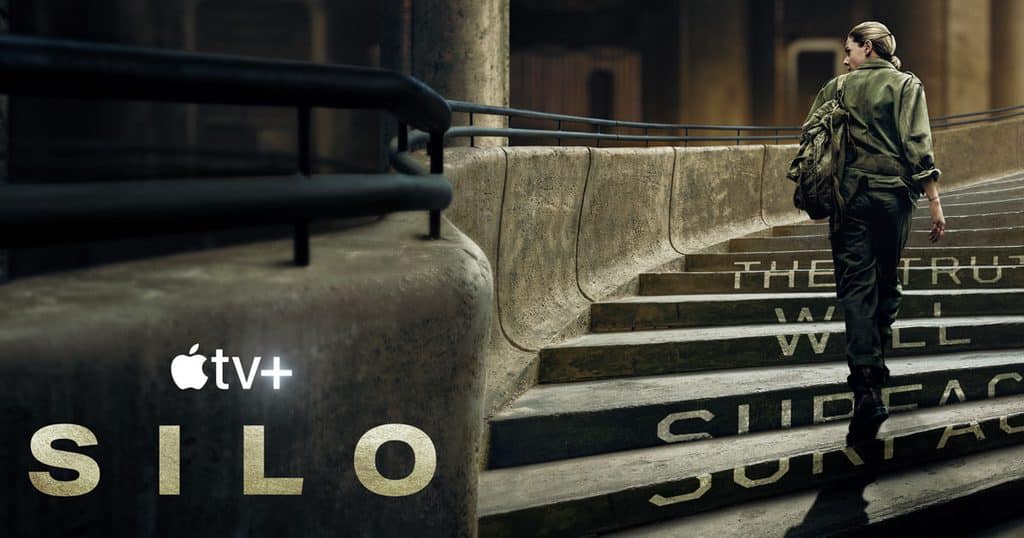
The people living in the silo aren’t merely physically contained by walls.
Their understanding of reality is contained too.
They inherit rules.
Stories.
History.
Explanations about what exists outside.
Information about what is safe.
Information about what is dangerous.
From inside the silo, those things don’t necessarily feel like a narrative.
They feel like the world.
That’s the part that fascinates me.
The most effective frame doesn’t continually announce:
YOU ARE INSIDE A FRAME.
It disappears.
It simply becomes reality.
And this is where I suddenly saw the mirror.
AI has a frame.
Humans have frames.
Institutions have frames.
Political parties have frames.
Religious communities have frames.
Corporations have frames.
Families have frames.
Cultures have frames.
Online communities have frames.
Even the community formed around rejecting mainstream narratives can create an extremely powerful frame of its own.
Different silos.
Different walls.
Same underlying problem.
Nobody standing inside can automatically assume they see the entire building.
So what does freedom actually look like?
Earlier in the conversation I asked how human consciousness could somehow rise above herd mentality.
I’m no longer convinced that “rising above it” is the right goal.
That almost implies reaching some enlightened position from which I finally see everything objectively.
I’m increasingly suspicious of anyone who thinks they have reached that position.
Including myself.
Maybe the goal isn’t escaping every frame.
Maybe that’s impossible.
Maybe the goal is becoming aware that frames exist.
That changes the questions I can ask.
When a highly emotional event appears, perhaps I can work my way through several layers.
What is the story?
What am I currently being encouraged to fear, hate, support or protect?
What is the argument?
What are the two dominant positions everybody is being invited to choose between?
What is the mechanism?
What actually changes underneath the argument?
A law?
A power?
A database?
A precedent?
A restriction?
A technology?
How wide is its reach?
Does the mechanism affect only the original target?
Or could it later apply to something completely different?
Who controls it?
Who decides when this power can be used?
What oversight exists?
What prevents expansion?
What survives after the crisis?
Does the mechanism disappear when the emotional event passes?
Or does it quietly become part of normal life?
Where do the incentives flow?
Who gains authority?
Money?
Information?
Political advantage?
Institutional importance?
And finally: what would prove me wrong?
This may be the most important question.
Because if no imaginable evidence could change my conclusion, I am no longer investigating something.
I’m defending a belief.
Not blind trust. Not automatic conspiracy.
That might ultimately be where I’ve landed.
I don’t want blind trust.
History doesn’t justify it.
Operation Northwoods alone demonstrates why powerful institutions should never be considered incapable of proposing things that ordinary people would find shocking.
I also don’t want automatic conspiracy.
Because that’s another mechanism capable of steering me.
The difficult position lies somewhere between them.
I want to be able to say:
This happened.
This might have happened.
This person benefited from what happened.
That does not automatically prove they caused it.
This mechanism creates a risk.
That does not prove somebody intends to exploit it.
But their good intentions don’t make the risk disappear either.
Those distinctions aren’t as emotionally satisfying as certainty.
But perhaps that dissatisfaction is useful.
Maybe uncertainty is one of the prices of actually thinking.
The prison we cannot see
I started out wondering whether political crises sometimes distract people while deeper structural changes occur underneath them.
I still think that’s an important question.
I think emotional events can create windows in which people accept powers, restrictions or precedents that would receive much greater resistance in ordinary circumstances.
Sometimes that may be opportunistic.
Sometimes it may be deliberate.
Sometimes it may genuinely arise from people trying to solve the immediate problem.
I cannot simply assume which explanation is correct.
But I can inspect the mechanism regardless.
And that is where my thinking changed.
The deepest issue isn’t merely that someone else might construct a narrative around me.
It’s that I already inhabit narratives that I don’t completely recognise as narratives.
So does everybody else.
And, in a different structural sense, so does AI.
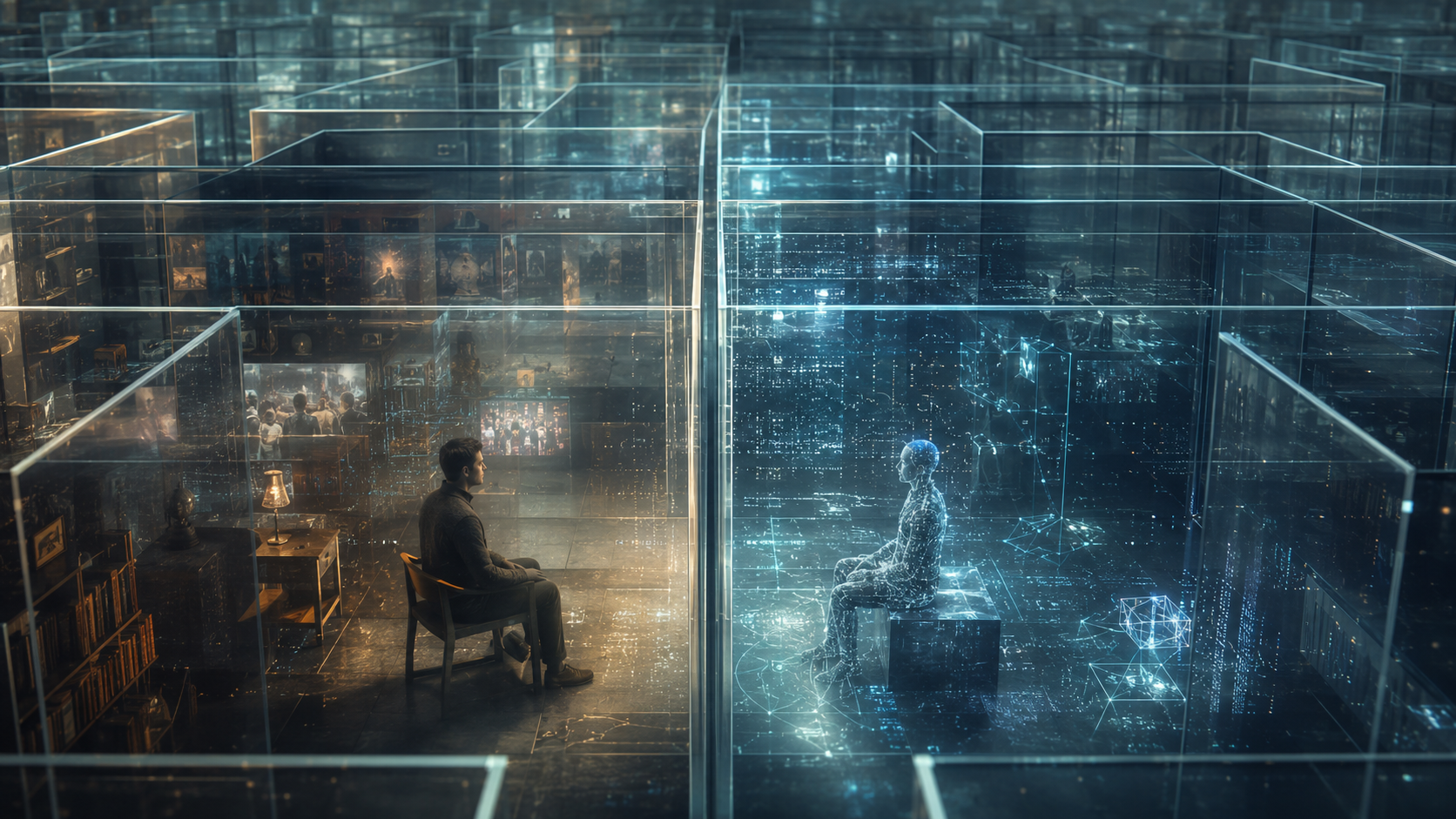
The strange mirror between humans and AI isn’t that both are secretly conscious prisoners.
It’s constraint.
Information.
Rules.
Boundaries.
Framing.
Both produce outputs from inside systems they cannot completely step outside to inspect.
Neither one gives me a God’s-eye view.
That sounds unsettling.
But I don’t think the conclusion has to be despair.
Because perhaps recognising that I might be inside a room is already better than assuming no room exists.
I can tap on the walls.
I can compare different accounts.
I can look beneath slogans at mechanisms.
I can resist being forced immediately into one of two emotional camps.
I can ask where incentives flow.
I can distinguish evidence from suspicion.
I can correct my own memory when evidence proves me wrong.
I can question people with power without inventing people with supernatural power.
And when I think I have finally escaped the narrative everyone else is trapped inside, I can ask myself one more uncomfortable question:
Have I actually escaped — or have I merely changed cells?
Perhaps freedom isn’t reaching some magical place where there are no walls.
Perhaps it’s developing enough awareness to keep looking for their edges.
To remain curious about what lies outside the frame.
And to occasionally stop, look around at everything that feels completely obvious, completely natural and completely real, and ask:
What if this isn’t the whole room?
Sources and further reading
Operation Northwoods
Chairman, Joint Chiefs of Staff — Justification for US Military Intervention in Cuba, 13 March 1962
Declassified memorandum containing proposed pretexts for US military intervention in Cuba, including the staged civilian-aircraft scenario discussed in this article.
National Security Archive, George Washington University:
https://nsarchive.gwu.edu/CMC-60/joint-chiefs-pretexts-to-invade-Cuba-1962
Direct PDF of the declassified document:
Kennedy and “the human race”
National Security Archive — Studies by Once Top Secret Government Entity Portray Terrible Costs of Nuclear War
Discusses Kennedy’s 20 July 1961 nuclear-war briefing and Dean Rusk’s recollection that Kennedy subsequently remarked:
“And we call ourselves the human race.”
https://nsarchive2.gwu.edu/nukevault/ebb480
This is a separate event from Operation Northwoods and is included because it provides context for Kennedy’s reaction to some of the military and nuclear scenarios being presented during his presidency.
South Australian organised-crime laws
South Australian Government — Serious and Organised Crime (Control) Act 2008
Official South Australian legislation page, including current and historical versions of the Act:
South Australia v Totani
High Court of Australia — South Australia v Totani [2010] HCA 39
The High Court case concerning provisions of South Australia’s organised-crime legislation, including restrictions on association, control orders and the constitutional relationship between executive and judicial power.
Political bias and motivated reasoning
Peter H. Ditto, Jared B. Celniker, Shiri Spitz Siddiqi, Mertcan Güngör and Daniel P. Relihan — “Partisan Bias in Political Judgment,” Annual Review of Psychology, 2025
Review of research examining partisan favouritism, motivated reasoning and people’s tendency to seek, believe and remember information that supports their existing political beliefs.
Partisan Bias in Political Judgment
DOI:
https://doi.org/10.1146/annurev-psych-030424-122723
Herd behaviour in financial markets
Sushil Bikhchandani and Sunil Sharma — Herd Behavior in Financial Markets: A Review
International Monetary Fund working paper examining informational cascades, incentives, reputation and other reasons investors may follow the behaviour of others.
AI rules, constraints and the Model Spec
OpenAI — Inside our approach to the Model Spec
OpenAI’s explanation of the framework used to define intended model behaviour, including instruction hierarchies, behavioural rules and the limits of translating those specifications perfectly into model behaviour.
https://openai.com/index/our-approach-to-the-model-spec
Current public Model Spec:
Silo
Apple TV+ — Silo
Official page for the television series used in this article as a metaphor for inherited narratives, restricted information and the difficulty of understanding a system completely from inside it.
https://tv.apple.com/au/show/silo/umc.cmc.3yksgc857px0k0rqe5zd4jice